Gardenist: The Decorative Serif That Redefines Brand Elegance
Every brand has a story, but not every brand knows how to tell it visually. You might have the perfect mission statement and a color palette that pops, but if your typography feels generic, you risk blending into the noise. Enter Gardenist, a decorative serif typeface that doesn’t just sit on the page—it commands attention. It strikes a rare balance between the ornamental charm of classic calligraphy and the clean utility required for modern digital platforms. For designers and business owners looking to inject personality into their work, this typeface offers a toolkit of elegance, featuring intricate details, flowing serifs, and a suite of stylistic alternates that transform standard text into visual art.
Beyond the Standard Serif: Understanding the Aesthetic
When we talk about a premium font, we are usually looking for something that feels "finished." Many free fonts feel like rough drafts, but Gardenist presents a polished, sophisticated presence. It is classified as a display font, meaning it is designed to be noticed. While you wouldn't use it to write a 50-page technical manual, it is the perfect candidate for headlines, hero text, and anywhere you need to make an immediate emotional impact.
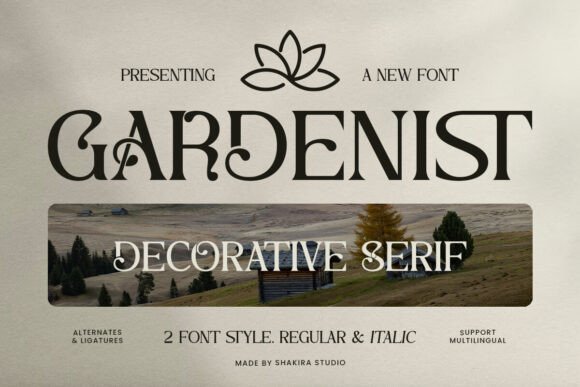
The visual personality of Gardenist lies in its intricate ornamental serif design. Unlike standard serif fonts that can feel corporate or academic, Gardenist feels organic and luxurious. The "feet" of the letters have a distinct, decorative flair, and the curves flow with a rhythm that feels almost handcrafted. This makes it an exceptional choice for editorial design and high-end branding where the typography needs to evoke a specific mood—be it romantic, vintage, or avant-garde.
Practical Applications: Where Gardenist Shines
A font is only as good as its utility. While Gardenist is undeniably artistic, its versatility is what makes it a valuable design asset. Here is how you can apply this typeface across various mediums to elevate your visual communication.
Luxury Branding and Logo Design
For businesses in the fashion, beauty, or lifestyle sectors, a serif font is often the go-to choice for establishing trust and elegance. Gardenist takes this a step further. Because of its unique alternates and ligatures, it allows you to create a logo design that is entirely bespoke. You aren't just typing out a name; you are curating a visual identity. By swapping out standard letters for the stylistic alternates, you can ensure that your brand mark is truly one-of-a-kind, aiding in brand recognition.
Packaging and Product Presentation
Imagine walking down a grocery aisle or browsing a shelf of artisanal candles. The products that catch your eye usually have packaging design that communicates quality instantly. Gardenist is perfect for labels, boxes, and tags. Its high legibility at medium sizes ensures that product names are readable, while its decorative nature suggests that the product inside is crafted with care. It pairs beautifully with textured paper stocks and foil stamping, adding a tactile quality to the visual experience.
Digital Presence: Websites and Social Media
In the realm of web design, headers and hero sections are prime real estate. Using a bold, decorative typeface like Gardenist for your H1 and H2 tags can instantly set the tone of your website. It breaks the monotony of standard web-safe fonts. Similarly, for social media graphics, this font is a powerhouse. Whether you are creating quote cards for Instagram, promotional banners for Facebook, or thumbnails for Pinterest, Gardenist adds a layer of professionalism and aesthetic appeal that encourages engagement.
The Power of Alternates and Ligatures
One of the standout features of Gardenist is the inclusion of stylish alternates and ligatures. If you are new to typography, an alternate is a different version of a specific letter, while a ligature is a character that joins two or more letters together.
Why does this matter for your project? It solves the problem of repetition. If you have a word with two identical letters next to each other (like "ll" or "oo"), standard fonts can make them look rigid. Ligatures merge them into a single, flowing shape. Alternates allow you to swap a standard "A" for a more decorative version to give your logo a specific flair. This feature is essential for creative fonts, as it gives you the control to fine-tune the personality of your text without needing to be a calligrapher.
Strategic Typography: Improving Brand Consistency and Engagement
Choosing a font is a strategic decision, not just an artistic one. The typography you choose acts as the voice of your brand. Using a modern typeface like Gardenist helps bridge the gap between traditional elegance and contemporary style.
When you use a consistent font family across your marketing materials—from your website headers to your email newsletters and printed brochures—you build a cohesive brand identity. This consistency signals professionalism to your audience. It tells them that you pay attention to details. Furthermore, the right font improves audience engagement. Decorative fonts like Gardenist are excellent for "stopping the scroll." They capture attention long enough for the viewer to read your message.
Technical Versatility and File Formats
A beautiful font is useless if it doesn't work with your software. Gardenist is designed for easy integration. It comes in multiple file formats—OTF, TTF, and WOFF—ensuring compatibility whether you are working in Adobe Photoshop, Illustrator, InDesign, or even Microsoft Office.
This multilingual support is another critical feature for global brands. If you are creating assets for an international market, you need to know that your typography supports various accents and characters. Gardenist provides comprehensive language support, making it a reliable choice for global marketing assets.
Practical Advice for Using Gardenist
To get the most out of this display font, consider these practical tips for implementation:
- Font Pairing is Key: Because Gardenist is ornamental and detailed, it pairs best with a clean, simple sans serif font or a neutral script font for body text. You want the contrast to be clear. Use Gardenist for the headlines to draw the eye, and a simple sans serif for the paragraph text to ensure readability.
- Check Your Licensing: Before using Gardenist in commercial projects—such as merchandise, client work, or digital products—always review the commercial licensing terms included with the download. This ensures you are legally covered for your specific usage.
- Test for Readability: While Gardenist is legible, decorative fonts generally perform best at larger sizes. Avoid using it for small body copy in dense paragraphs. It is optimized for headers, titles, and short bursts of text where its details can be appreciated.
- Explore the Glyphs: Don't just install the font and start typing. Open the Glyphs panel in your design software to explore all the available characters. You might find a unique swash or tail that transforms a standard word into a custom masterpiece.
Conclusion: Elevating Your Visual Language
In a crowded digital landscape, the details matter. Gardenist is more than just a collection of letters; it is a tool for visual storytelling. Whether you are designing invitations for a gala, creating editorial layouts for a magazine, or branding a new luxury startup, this typeface offers the flexibility and elegance required to make your work stand out. By combining ornamental beauty with modern utility, Gardenist helps you craft a professional presentation that resonates with your audience and elevates your creative projects to a new standard of excellence.